

Lost in Plain Sight
(A Cortical Visual Impairment Story)

I arrived late to my sub job that day, as was my usual. Getting ready for work in the morning was a bear with all the sensory issues I dealt with. Everything seemed to take twice as long as it ought to. I walked hurriedly into the second grade classroom I was assigned to for the day. The walls were covered in posters, student artwork, words, diagrams, math facts, alphabets and numbers, calendars, hall passes and countless other things. The twenty seven desks each overflowed with stickers, names, reward points, crayons, pens, pencils, math minipulatives and more. The room was lined with shelves, bins, cubbies, cushions for kids to sit on and shapes I could not identify hung from the ceiling. Just walking in raised my anxiety. I sat down at the teacher’s desk and looked for sub plans, but found none. Growing concerned and seeing the clock ticking precariously close to the start of school, I headed next door to ask the neighboring teacher if she knew where they were.
“Hi,” I said in my friendliest voice.
“Hi,” the teacher sounded harried and she probably was.
“I’m subbing for your neighbor and I don’t see any sub plans. Do you know where they might be?” I kept my voice casual.
“She didn’t leave any. Come on, I’ll show you what to do.” She stood and lead me back to the second grade classroom I’d come from. We stopped next to the teacher’s desk. “I’ll write it down for you. It’s really easy today. You won’t have to do much. Hand me that blue pen.” She pointed to the teacher’s desk.
I looked down. What had once looked like a perfectly normal (albeit extremely cluttered) desk had disintegrated into a morass of unidentifiable objects. It was as if someone had erased all the lines from all the objects, removing every identifying feature from them, leaving only size, shape and color. I had no way of picking up the blue pen because to me, no such thing existed. Frantically, I searched the desk surface for something that might logically be a ‘blue pen’.
Even though I just said I saw size, shape and color, in that moment, I lacked the ability to identify any color or describe any size or shape. It all just was.
It existed as abstract art in my visual field.
I knew I had precisely three seconds to perform this impossible task. Any more and the teacher next to me would become exasperated by my inability to pick it up. I knew this from experience. Most people had little to no tolerance for the laborious process I underwent to locate items visually. Take too long, and you’ll get scolded. It happened every time.
My estimate of how long I had to locate the item turned out to be right on. Three seconds in and I heard an exasperated sigh. I felt her frustration and impatience. My heart raced and I felt weak in the knees, knowing I was incapable of locating the blue pen. Finally, she reached onto the desk and grabbed it. In the moment that she touched the pen, the entire scene came back. All the identifying features returned and it became obvious where the pen had been. Once again, I was able to name colors, shapes, sizes, objects and everything else on the desk.
She glared at me as she wrote the note, as if I’d intentionally not picked up the pen in order to irk her. I felt her glare every time I looked at the note that day.
Here’s what the world might look like to a person with CVI:
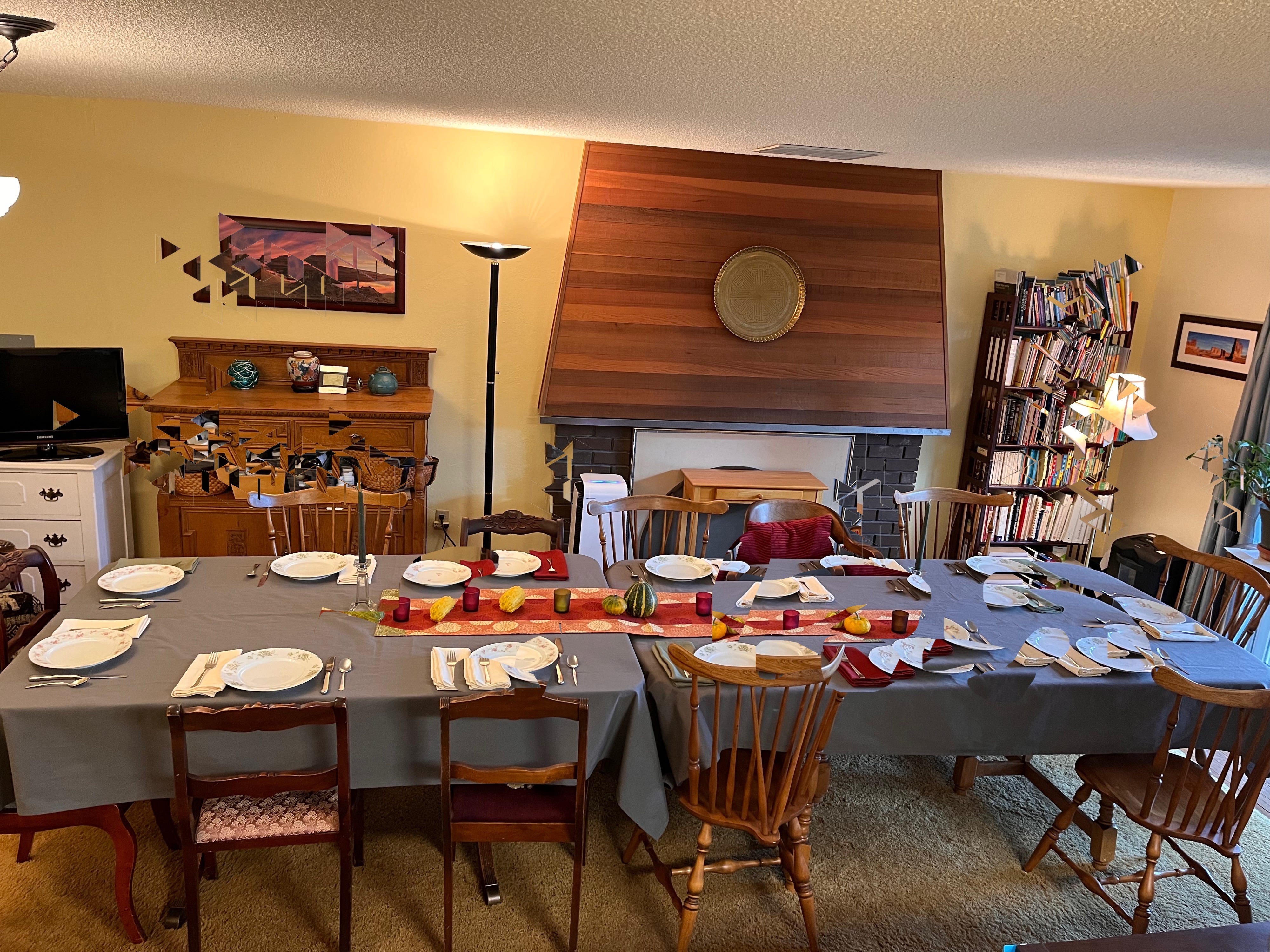
Why did that happen? Why did a perfectly average classroom become indecipherable to me? The answer is simultaneously simple and complex. What I know now that I did not know then is that I likely have Cortical Visual Impairment (CVI), a visual impairment of the brain that means that, while my eyes are fine, my brain has a hard time interpreting what I’m looking at. What do I mean by ‘interpreting’? When I looked at the desk after the teacher asked me to pick up the blue pen, my brain was unable to figure out what I was looking at, which meant that what had previously been identifiable objects were now meaningless, colored shapes. Hence the scene looking like abstract art. The desk no longer looked like a desk, it looked like random shapes, sizes and colors.
It was like the visual world suddenly became a foreign language. What would you do if a person suddenly began to speak to you in a language you did not know? Would you be able to follow directions? Respond logically to them? Retrieve an object they asked you for? This is what can happen to a person with CVI, except instead of verbal language, it happens with the visual world.
Why was I able to see the classroom moments before, but not when the teacher asked me for the pen? I’m not sure. I can hazard a guess though. To do that, let’s learn a little more about CVI.
We’ll look at three aspects of my experience:
1. Visual Complexity: Complexity of the surface
2. Visual Complexity: The sensory environment
3. How internal experiences impact vision
1. Visual Complexity: Complexity of the surface. People with CVI see best in very specific environments. Clutter (also known as visual complexity) is the biggest problem for people with CVI. The more clutter in an environment, the harder it is for the brain to figure out what it’s looking at. It’s the visual equivalent of trying to follow a conversation in an increasingly loud environment. Eventually, it’s just too loud to hear anything.
Do you remember what the classroom looked like? Super busy. There was stuff EVERYWHERE. That meant I was already struggling to see, even though I didn’t realize it at the time. Strike one for my visual system.
2. Visual Complexity: The sensory environment. Another aspect of CVI is that the more stuff people with CVI are perceiving with their senses (sights, sounds, smells, etc.) the harder it is to figure out what they’re seeing. This is usually a totally subconscious issue. Before I understood about CVI, I rarely said to myself, “My sensory environment is highly complex right now, so I’m having difficulty seeing.” I just knew that in loud, busy places, everything felt hard.
When I arrived in the classroom and sat at the desk by myself, it was quiet. That meant my brain wasn’t trying to hear and see at the same time, which made it easier. But when the teacher was there talking to me, that made it harder for my brain to interpret what I saw. Strike two.
3. How internal experiences impact vision. The last aspect of CVI I’ll talk about in this post is that things like hunger, anxiety, fatigue or any other internal experience that is challenging makes it harder for us to use our vision. This has certainly been true for me. Growing up, when I was hungry or tired, I hated looking at things. But if I felt rested and had recently eaten, I could try out visual activities, at least for short periods of time. Why is that? People with typical vision have a lot of redundant neural networks in their brains to process vision. That means that when they’re hungry or tired and their brain is a little compromised, there are extra neural networks that can jump in and do the job. This neurological redundancy means that they can use their vision just as easily when hungry as they can when they’re full. People with CVI however, have FAR fewer neural networks that process vision, so when we’re hungry, tired or stressed, we don’t have any extra networks to do the job. That means we don’t see as well when we’re not on top of our game.
How did I feel when the teacher was talking to me? Totally stressed out! This knocked out some of my visual network, which meant it made it harder to see. Strike three. No more desk, just abstract art.

My kids and I don’t have CVI, so this isn’t relevant to me, right? Actually, this is relevant to everyone.
Let’s go back to our foreign language analogy. Have you ever studied another language? Perhaps you took high school Spanish or German. Some of you may have studied abroad for a semester or majored in a foreign language in college. So you are probably aware that there are varying levels of proficiency in foreign languages. A person who took two years of high school Spanish won’t know it as well as someone who majored in Spanish and lived in Mexico for a year. How much proficiency would it take to be able to live in a country that speaks the language? Typically, it takes 2-4 years of practice to be able to meet your daily living needs in a foreign language and 5-7 years to be able to learn academics in a new language.

Just like it is totally possible for different people to have different levels of proficiency in learning new languages, different people also have different levels of proficiency with visual perception. Some people have diagnosable CVI. Others may have all the diagnostic criteria but one. Still others may have several characteristics, but would never consider themselves visually impaired. Any one of these people could struggle with their vision enough to make daily living difficult or even impossible. Just because someone lacks a diagnosis of CVI, doesn’t mean they can’t have some level of visual perceptual difficulty. Any amount of visual perceptual difficulty can make life harder.
If your world only looked half as confusing as the photo above, would it be any easier to live in?
Here are some commonly observed behaviors associated with CVI. Have you ever known anyone who did any of these things?
Not looking at faces when talking to someone or only glancing at faces.
Not able to identify objects in the distance. (By distance, I mean anywhere from 12 inches to 20 feet away from their eyes.)
Needing to stare at something for a long time before knowing what you’re looking at.
Not being curious about your visual world.
Getting tired easily, especially after visual tasks. (Visual fatigue can be so extreme that it can cause a person to feel like they’re coming down with the flu, need long naps and/or sleep for 12-14 hours per night. When the brain struggles, it is profoundly tiring.)
Seeing objects of a certain color more easily. (For example, a child with CVI might see big, yellow objects like Big Bird better than green, pink or orange objects like patterned blanket or cup.)
Staring at lights, staring out windows or needing light to see things that other people see easily.
This is only a short list of observable behaviors associated with CVI. But imagine what life might be like if you lived with some or all of these experiences. How would it impact your social life, for example? Would you be able to navigate independently to get to restaurants to see your friends? Would you be able to find your friends in restaurants? Would you have the energy to see friends? I didn’t. I was so exhausted I could hardly get off the sofa.
Identifying people with CVI and giving them the accommodations they need makes the world accessible to them. It gives them opportunities that non-visually impaired people have. When kids with CVI aren’t identified, they struggle in school, are more prone to anxiety and depression, are more likely to experience social isolation and are less likely to be able to do what they want to do with their lives.
Figuring out that I had CVI dramatically changed my life for the better. Having used CVI accommodations for several years and taking advantage of other neuroplastic approaches has improved my vision to the point where I am no longer exhausted. I can do whatever I want, whenever I want. My improved vision is important to me because it means I don’t get scolded for not seeing things anymore. The most important improvement though, is having enough energy to do what I want to do. But, every person with CVI is different and everyone’s goals are different.
How common is CVI? It’s the most common visual impairment among school aged children in the developed world.
While any given teacher might not have a student with CVI in their career, it is extremely likely that any given school will have one or more students with CVI at some point in time. CVI is extremely under-identified. Why? Because not many people know about it. I think it is critical for parents and teachers to have at least a basic familiarity with CVI so that they can help identify kids who have it.
What do you do to help someone with CVI? Stay tuned for further blog posts…
Like what you read? Share it! Help me spread the word about CVI and other neruoplasticity topics.